ByMathew

In the world of modern medicine, discovering a new drug is no longer just about mixing chemicals in a lab and hoping for the best. Today, computers play a powerful role in predicting how drugs will behave long before they are tested on real cells or patients. One of the most important techniques behind this revolution is molecular docking.
So, what exactly is molecular docking, and why does it matter?
What Is Molecular Docking?
Molecular docking is a computer-based method used to predict how two molecules interact with each other. Most commonly, it studies how a drug molecule (ligand) binds to a target protein in the body.
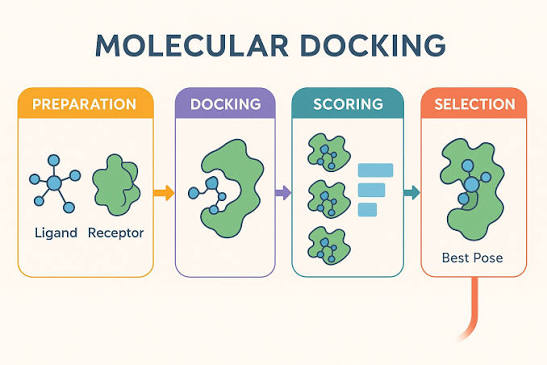
Think of it like this:
The protein is a lock
The drug is a key
Molecular docking tries to figure out:
Which key fits the lock best
How strong that fit is
How the key sits inside the lock
Why Molecular Docking Is Important
Traditional drug discovery can take 10–15 years and cost billions of dollars. Molecular docking helps reduce both time and cost by allowing scientists to:
Test thousands of drug candidates virtually
Eliminate weak or ineffective compounds early
Focus lab experiments on the most promising molecules
Understand how drugs interact at the atomic level
.jpeg?alt=media&token=62c26f94-309b-418a-9f6f-a18cc7596267)
Final Thoughts
Molecular docking is a powerful bridge between biology, chemistry, and computer science. It allows scientists to visualize interactions that are impossible to see with the naked eye and make better decisions in drug development.
As technology advances, molecular docking will continue to play a key role in shaping the future of medicine—one virtual molecule at a time.

DATA XPRESSION
We are a dedicated team of experts transforming lives through the innovative application of Bioinformatics and Public Health Informatics. By harnessing the power of data science, computational biology, and health informatics, we strive to advance medical research, improve healthcare outcomes, and promote public health.


Training
One-on-one guidance in bioinformatics.

Research
Help from idea to publication.

Consulting
Connect with experts and peers.
Services
Get in touch

Copyright. All rights reserved.